
Blog
IAM Chapter 6: The Whole Machine

Distinct components, working as one system.
On this page
Part of the IAM study series.
A short stop before Kerberos, to put Part 1 and Part 2 together.
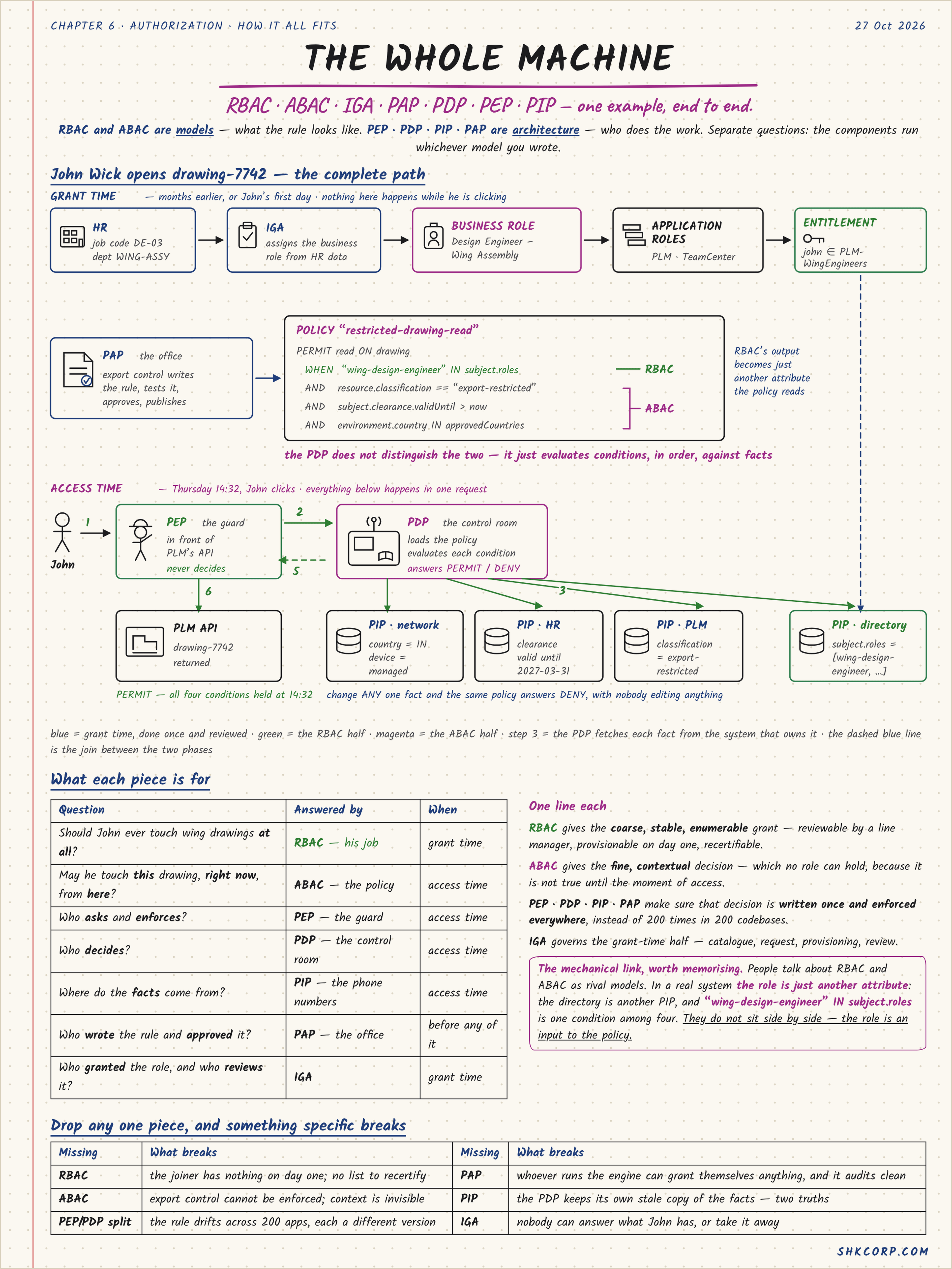
RBAC and ABAC are models: what the rule looks like. PEP, PDP, PIP, and PAP are architecture: who does the work. They answer separate questions, and the components run whichever model you wrote.
John Opens drawing-7742
At grant time, months earlier, nothing happens while John is clicking:
- HR records job code
DE-03in departmentWING-ASSY. - IGA assigns the business role Design Engineer – Wing Assembly from that HR data.
- The business role brings its application roles in PLM and TeamCenter.
- The result is an entitlement: John is in
PLM-WingEngineers.
Separately, export control writes a policy in the PAP, tests it, approves it, and publishes it:
PERMIT read ON drawing
  WHEN  "wing-design-engineer" IN subject.roles        ← RBAC
  AND   resource.classification == "export-restricted" ← ABAC
  AND   subject.clearance.validUntil > now             ← ABAC
  AND   environment.country IN approvedCountries       ← ABAC
At access time, Thursday 14:32, all of this happens in one request:
- John requests the drawing, and the PEP in front of PLM's API intercepts it.
- The PEP asks the PDP, sending subject, action, and resource.
- The PDP fetches each fact from the PIP that owns it: country and device from the network, clearance from HR, classification from PLM, roles from the directory.
- All four conditions hold, so the PDP answers PERMIT.
- The PEP lets the request through, and PLM returns the drawing.
Change any one fact and the same policy answers DENY, with nobody editing anything.
The Link Worth Memorising
People talk about RBAC and ABAC as rival models. In a real system the role is just another attribute. The directory is another PIP, and "wing-design-engineer" is one condition among four. They don't sit side by side: the role is an input to the policy.
What Each Piece Is For
| Question | Answered by | When |
|---|---|---|
| Should John ever touch wing drawings at all? | RBAC, through his job | Grant time |
| May he touch this drawing, right now, from here? | ABAC, through the policy | Access time |
| Who asks and enforces? | PEP, the guard | Access time |
| Who decides? | PDP, the control room | Access time |
| Where do the facts come from? | PIP, the phone numbers | Access time |
| Who wrote and approved the rule? | PAP, the office | Before any of it |
| Who granted the role, and who reviews it? | IGA | Grant time |
Drop One Piece, and Something Specific Breaks
| Missing | What breaks |
|---|---|
| RBAC | The joiner has nothing on day one, and there's no list to recertify |
| ABAC | Export control can't be enforced, because context is invisible |
| PEP/PDP split | The rule drifts across 200 apps, each a different version |
| PAP | Whoever runs the engine can grant themselves anything, and it audits clean |
| PIP | The PDP keeps its own stale copy of the facts |
| IGA | Nobody can answer what John has, or take it away |
So far John has simply been logged in. The next part looks at how that actually happens.
🔴 CHECKPOINT: Study Notes
← Previous: Deciding at the Door · Back to the series start · Next: Kerberos →