
Blog
Agentic AI Chapter 4: Tool Registry and Tool Schema
On this page
Part of the Agentic AI study series.
Two ideas that make tool calling safe and reliable.
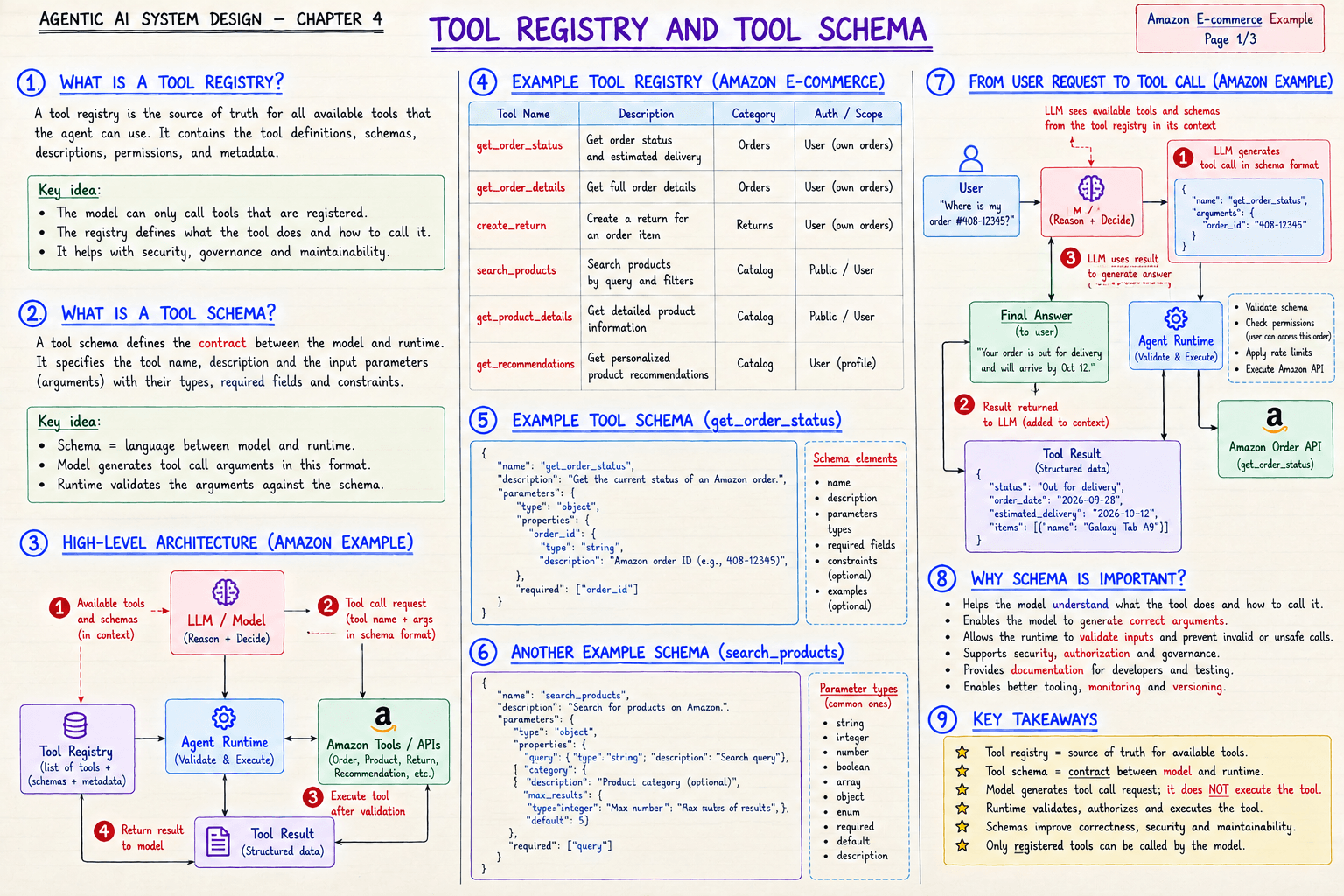
A tool registry is the source of truth for every tool the agent can use: definitions, schemas, descriptions, permissions, and metadata. A tool schema is the contract between the model and the runtime: the tool name, its description, and its input parameters with types and required fields.
📊 Real-World Example: An Amazon Tool Registry
| Tool | What it does | Category | Auth scope |
|---|---|---|---|
get_order_status | Order status and estimated delivery | Orders | User, own orders |
get_order_details | Full order details | Orders | User, own orders |
create_return | Create a return for an order item | Returns | User, own orders |
search_products | Search by query and filters | Catalog | Public or user |
get_product_details | Detailed product information | Catalog | Public or user |
get_recommendations | Personalized recommendations | Catalog | User profile |
A schema for get_order_status names the tool, describes it ("Get the current status of an Amazon order"), and declares one required string parameter, order_id.
🔴 CHECKPOINT: Remember
Why the schema matters:
✓ It tells the model what the tool does and how to call it ✓ It lets the model generate correct arguments ✓ It lets the runtime validate inputs and block invalid or unsafe calls ✓ It supports security, authorization, documentation, and versioning
Only registered tools can be called by the model. The schema is the contract, and the runtime enforces it.
ðŸ› ï¸ From My Own Work
The same idea shows up as an allow-list of what an assistant may run in my project. If an action is not on the list, it has to ask first.
↠Previous: Tool Calling · Back to the series start · Next: Tool Execution and Observability →