
Blog
Agentic AI Chapter 9: Agent Runtime Boundaries
On this page
Part of the Agentic AI study series.
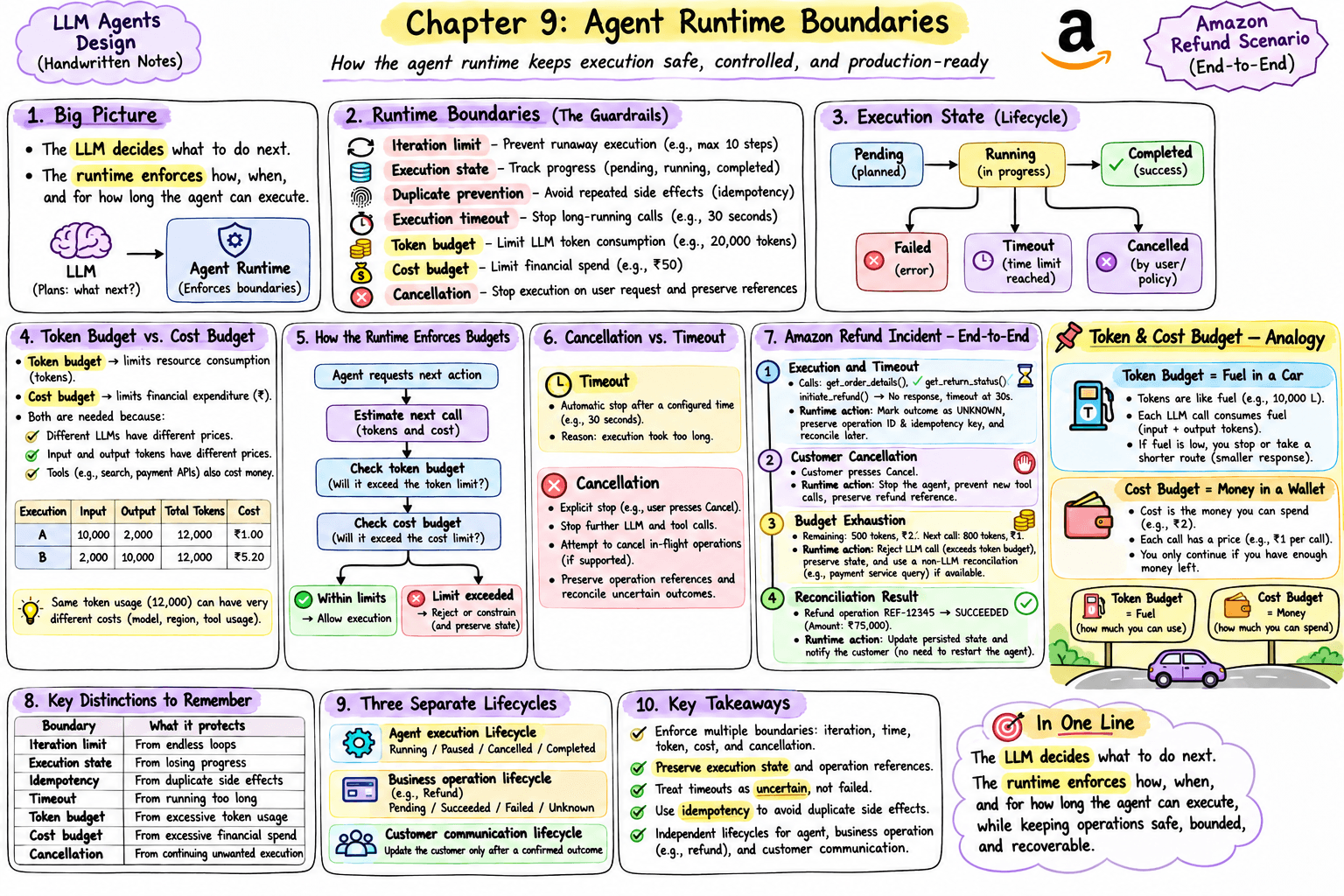
An agent needs room to reason and act. It also needs boundaries. The model may propose the next step, but a runtime decides whether that step can run, tracks its outcome, and stops execution when a limit is reached.
What the runtime controls
The runtime is the operational layer around the model and its tools. It can enforce an iteration limit, an execution timeout, a token budget, a cost budget, and user or policy cancellation. These limits solve different problems: a token budget limits model usage, while a cost budget limits money spent across model and tool calls.
The runtime also records execution state. A run might be pending, running, completed, failed, timed out, or cancelled. Keeping this state lets the system report progress and resume or reconcile work without pretending an interrupted operation succeeded.
One request, several lifecycles
Consider an agent handling a customer refund. The agent run can be cancelled while the refund operation is still pending or uncertain. Those are separate lifecycles: the agent execution, the business operation, and the customer communication.
If a refund call times out, the timeout only tells us that the runtime did not receive a response in time. It does not prove the refund failed. Preserve the operation ID and idempotency key, then check the payment or order system before retrying. Otherwise a second attempt could create a duplicate side effect.
Cancellation needs similar care. Stop future model and tool calls, attempt to cancel in-flight work when supported, and retain enough references to reconcile operations whose outcome is unknown. Notify the customer after the business outcome is confirmed.
Check budgets before each action
Before starting another model or tool call, estimate the expected token use and cost, then compare both with the remaining budgets. If either limit would be exceeded, reject or constrain the action and preserve the run state. The runtime can then explain why it stopped or offer a safe next step.
Checkpoint: remember
- The model decides what to do next; the runtime enforces how and whether it can run.
- Track execution state separately from the business operation's state.
- A timeout creates an uncertain outcome, so reconcile before retrying side effects.
- Use iteration, time, token, cost, and cancellation limits together.
- Preserve operation references so a stopped run can be investigated or resumed safely.
← Previous: Human-in-the-Loop and Persistence · Back to the series start · Next: Error Handling and Recovery →